

Two very different products are being sold under one word. One tells you who a known contact is. The other adds a subscriber you never had.
Ask five vendors whether they do identity resolution and all five will say yes. Ask what happens to your list size after 30 days and the answers stop matching.
The confusion is understandable. Both categories use the same vocabulary — pixel, match rate, resolved visitor, identity graph. But they solve opposite halves of the problem, and only one of them grows your addressable audience. Knowing which you are buying is the difference between paying to recognize people you already email and paying to reach people you never could.
Resolution ID: recognizing someone you already know
Platforms like Klaviyo and Triple Whale sit on top of the contact data you already own. Their job is to connect an anonymous browsing session back to a profile that is already in your database — someone who subscribed last spring, bought once in 2024, or clicked an email this morning on a different device.
The mechanism is usually a first-party cookie or a click identifier. When a known contact opens your email and lands on the site, the platform stamps the session and remembers the browser. Later visits are attributed to that profile without the visitor doing anything.
What you get: better attribution, smarter segmentation, on-site personalization, and browse-abandon flows for contacts already on your list. Real value — but the list itself does not grow by a single address.
Net new identification: adding someone you never had
Platforms like Retention.com, Opensend, Tie and Justuno Spotlight work from the other direction. They match anonymous traffic against a third-party identity graph and return contacts that were never in your database — visitors who browsed, left, and never filled out a form.
This is a genuinely different capability. It expands the audience you are allowed to market to rather than sharpening what you do with the audience you have. It also carries obligations resolution ID does not: consent posture, deliverability risk from sending to people who never opted in, and a bill that scales with volume.
The catch: not every contact returned is actually new. If a vendor bills per resolved contact and does not suppress against your existing list first, you are paying again for subscribers you already own.
Same traffic, different slice
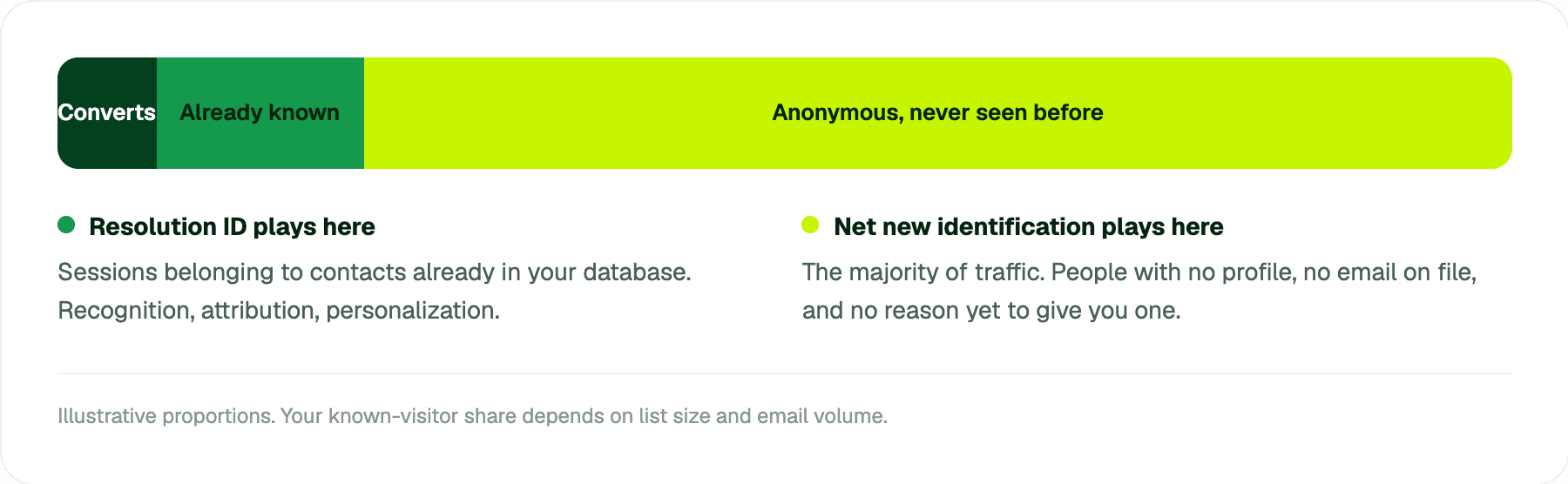
Illustrative proportions. Your known-visitor share depends on list size and email volume.
Resolution ID plays in the sessions belonging to contacts already in your database: recognition, attribution, personalization. Net new identification plays in the majority of traffic — people with no profile, no email on file, and no reason yet to give you one.
Who actually offers what
Read the middle two columns together. A platform that only fills the first one cannot grow your list, no matter how good its match rate sounds.

Positioning summary based on how each category is sold. Capabilities and pricing change — confirm current terms with each vendor.
Overlap is the hidden line item
The cost of an identification tool is not its rate card. It is the rate card divided by the number of contacts you did not already have.
If a vendor resolves 10,000 visitors in a month and 4,000 of them are already active subscribers, you paid for 10,000 and grew by 6,000. Your real cost per net new subscriber is 67% higher than the number on the invoice. Suppression against your live list, before billing, is what closes that gap.
Ask every vendor the same three questions: Do you suppress against my current list before I am charged? Do you bill on resolved contacts or on net new ones? And what happens to the contacts I already had — do they show up as growth?
Pay for the subscribers you gained, not the ones you had
Justuno Spotlight identifies anonymous visitors and checks every match against your existing list before it counts. What lands in your ESP is a subscriber you did not have this morning, and that is the only thing you are billed for.
Deduped by default. Existing subscribers are suppressed before a match becomes a charge.
One growth stack. Runs alongside your on-site capture, so opt-in and identified contacts stay in one system.
Clear unit cost. Cost per net new subscriber is the metric, not cost per resolution.
How to decide
If the problem is that your flows are firing at the wrong time and attribution is muddy, you need resolution ID, and you probably already own it inside your ESP or analytics platform.
If the problem is that the list has plateaued while traffic has not, you need net new identification — and the only version of it worth paying for is the one that charges you for growth.

